
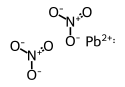
Lead(II) nitrate
Athanor · official
N2O6Pb · 331 g/mol
IUPAC name: lead(2+) dinitrate
Also called plumbous nitrate


 DangerMay intensify fire; oxidizer · Harmful if swallowed or if inhaled · Harmful if swallowed · May cause an allergic skin reaction · Causes serious eye damage · Harmful if inhaled · Suspected of causing cancer · May damage fertility or the unborn child · May damage the unborn child; Suspected of damaging fertility · Causes damage to organs through prolonged or repeated exposure · May causes damage to organs through prolonged or repeated exposure · Very toxic to aquatic life · Very toxic to aquatic life with long lasting effects
Names and identifiers
- IUPAC name
- lead(2+) dinitrate
- Synonyms
- plumbous nitrate, LEAD NITRATE, Lead dinitrate
+ 36 more
Plumbous nitrate, Lead(2+) nitrate, Lead nitrate (Pb(NO3)2), Nitrate de plomb, Lead(II) nitrate (1:2), Nitric acid, lead(2+) salt, DTXSID2035069, Nitric Acid, Lead (2+) Salt, 6E5P1699FI, (nitrooxy)plumbyl nitrate, RefChem:152643, LEAD(2+) BIS(NITRATE), DTXCID201478105, 233-245-9, (Pb(NO3)2), CHEBI:37187, Pb(NO3)2, MFCD00011153, Lead (II) nitrate, Nitric acid, lead(2+) salt (2:1), Lead(II)nitrate, Nitrate de plomb [French], CCRIS 1945, HSDB 637, N2O6Pb, EINECS 233-245-9, UN1469, UNII-6E5P1699FI, plumbous;dinitrate, lead(2+);dinitrate, 0.1M Lead nitrate, LEAD NITRATE [MI], EC 233-245-9, Lead Nitrate Stock Solution, LEAD NITRATE [HSDB], SCHEMBL155278
- Molecular formula
- N2O6Pb
- Empirical formula
- N2O6Pb
- Molecular weight
- 331 g/mol
- Exact mass
- 331.95229
- CAS number
- 10099-74-8
- PubChem CID
- 24924
- Canonical SMILES
- [N+](=O)([O-])[O-].[N+](=O)([O-])[O-].[Pb+2]
- Isomeric SMILES
- [N+](=O)([O-])[O-].[N+](=O)([O-])[O-].[Pb+2]
- InChI
- InChI=1S/2NO3.Pb/c2*2-1(3)4;/q2*-1;+2
- InChIKey
- RLJMLMKIBZAXJO-UHFFFAOYSA-N
- Molfile
Names, InChI and the identifiers from PubChem, retrieved 2026-10-14.
Physical properties
- Appearance
- Lead nitrate is a white crystalline solid. The material is soluble in water. It is noncombustible but it will accelerate the burning of combustible materials. If large quantities of the material are involved in the fire an explosion may result. Prolonged exposure of the material to fire or heat may result in an explosion. Toxic oxides of nitrogen are produced in fires involving this material.[1]
3 values
From CAMEO Chemicals, the most authoritative source here.
Value As written Source –shown Lead nitrate is a white crystalline solid. The material is soluble in water. It is noncombustible but it will accelerate the burning of combustible materials. If large quantities of the material are involved in the fire an explosion may result. Prolonged exposure of the material to fire or heat may result in an explosion. Toxic oxides of nitrogen are produced in fires involving this material. [1] CAMEO Chemicals – Liquid; Dry Powder; Other Solid; CBI [2] EPA Chemical Data Reporting (CDR) – WHITE OR COLOURLESS CRYSTALS. [3] ILO-WHO International Chemical Safety Cards (ICSCs) - Melting point
- 470 °C[5]
- Density
- 4.53 @25 °C[5]
3 values
3 of 3 sources agree on it (most common value).
Value As written Source – 4.53 at 68 °F (USCG, 1999) - Denser than water [1] CAMEO Chemicalscites U.S. Coast Guard. 1999. Chemical Hazard Response Information System (CHRIS) - Hazardous Chemical Data. Commandant Instruction 16465.12C. Washington, D.C.: U.S. Government Printing Office. – Relative density (water = 1): 4.6 [3] ILO-WHO International Chemical Safety Cards (ICSCs) –shown 4.53 @25 °C [5] PAC Chemical Database, U.S. Department of Energy - Solubility in water
- Solubility in water, g/100ml at 20 °C: 52[3]
Each value as its source reports it, with the source's number after it (listed under References). Where several sources report a property, the row shows the value most of them agree on, the rule the app uses; open the values to see every one.
Calculated
- Heavy atoms
- 9
- Rings
- 0
- Aromatic rings
- 0
- Fraction sp³ carbons (Fsp3)
- 0
- H-bond donors
- 0
- H-bond acceptors
- 6
- Rotatable bonds
- 0
- TPSA (Ų)
- 132.4 computed here · PubChem 126
- Formal charge
- 0
- Complexity
- 18 PubChem
- Stereocenters
- None
- Double-bond geometry
- None specified
- Point group
- D3h of one 3D conformer with its hydrogens, by Athanor’s engine (as in the app)
Elemental analysis
- N8.46%
- O28.98%
- Pb62.56%
Isotope pattern
Each peak is a nominal mass with its abundance-weighted exact mass, as a percentage of the tallest, from IUPAC natural isotope abundances.
Computed from the structure with RDKit 2026.09 when this page was built, beside PubChem's own computed values from its record; where the two differ, both are shown.
Predicted
- log P
- -0.86 Crippen (Wildman and Crippen 1999)
- log S (water solubility)
- -1.35 ESOL (Delaney 2004), log mol/L
- Synthetic accessibility
- 3.05 SA score, 1 easy to 10 hard (Ertl and Schuffenhauer 2009)
Drug-likeness: Lipinski’s rule of five
- Molecular weight ≤ 500: 331.21
- log P ≤ 5 (Crippen): -0.86
- H-bond donors ≤ 5: 0
- H-bond acceptors ≤ 10: 6
Passes all four rules.
Predictions, not measurements; each names its method. A measured log P, where a source reports one, is under Physical properties.
Safety
Danger
Most widely reported: 318 company reports to ECHA. Source [6].
- Oxidizer
- Corrosive
- Harmful or irritant
- Health hazard
 Environmental hazard
- H272May intensify fire; oxidizer (13.5% of reports)
- H302+H332Harmful if swallowed or if inhaled (39.6% of reports)
- H302Harmful if swallowed (88.7% of reports)
- H317May cause an allergic skin reaction (48.4% of reports)
- H318Causes serious eye damage (78.9% of reports)
- H332Harmful if inhaled (88.7% of reports)
- H351Suspected of causing cancer (48.1% of reports)
- H360May damage fertility or the unborn child (34% of reports)
- H360DfMay damage the unborn child; Suspected of damaging fertility (61.6% of reports)
- H372Causes damage to organs through prolonged or repeated exposure (48.4% of reports)
- H373May causes damage to organs through prolonged or repeated exposure (47.2% of reports)
- H400Very toxic to aquatic life (88.7% of reports)
- H410Very toxic to aquatic life with long lasting effects (88.7% of reports)
Precautionary statements: P203, P210, P220, P260, P261, P264, P264+P265, P270, P271, P272, P273, P280, P301+P317, P302+P352, P304+P340, P305+P354+P338, P317, P318, P319, P321, P330, P333+P317, P362+P364, P370+P378, P391, P405, P501
View all classifications (2)
- [6] European Chemicals Agency (ECHA)This chemical does not meet GHS hazard criteria for 11.3% (36 of 318) of reports.
- [6] European Chemicals Agency (ECHA) · 318 reports · DangerH272, H302+H332, H302, H317, H318, H332, H351, H360, H360Df, H372, H373, H400, H410
Exposure limits
First aid
- Remove at once all cases of lead intoxication from further exposure until the blood level is reduced to a safe value; immediately place the individual under medical care. Ingestion: Give gastric lavage using 1% solution of sodium or magnesium sulfate; leave 15-30 gm magnesium sulfate in 6-8 oz. Of water in the stomach as antidote and cathartic; egg white, milk, and tannin are useful demulcents; atropine sulfate and other antispasmodics may relieve abdominal pain, but morphine may be necessary. EYES or skin: Flush with water. (USCG, 1999)[1]
- General First Aid: · Call 911 or emergency medical service. · Ensure that medical personnel are aware of the material(s) involved, take precautions to protect themselves and avoid contamination. · Move victim to fresh air if it can be done safely. · Administer oxygen if breathing is difficult. · If victim is not breathing: -- DO NOT perform mouth-to-mouth resuscitation; the victim may have ingested or inhaled the substance. -- If equipped and pulse detected, wash face and mouth, then give artificial respiration using a proper respiratory medical device (bag-valve mask, pocket mask equipped…[7]
- Fresh air, rest. Refer for medical attention.[3]
- Remove contaminated clothes. Rinse skin with plenty of water or shower.[3]
Storage
Incompatibilities
- Ignites or explodes when in presence of organic or easily oxidizable cmpd.[4]
- Many metal oxo-compounds (nitrates, oxides, and particularly sulfates) and sulfides are reduced violently or explosively (ie undergo "thermite" reaction) on heating an intimate mixture with aluminium powder to a suitably high temperature. Contact of massive aluminium with molten salts may give explosions. (metal oxo-cmpd)[4]
- Contact with red hot carbon causes an explosion with showers of sparks. If lead nitrate is used ... As the source of divalent lead, the crude dicyclopentadienyllead may explode violently during purification by high-vacuum sublimation at 100-130 °C. A heated mixture of (lead nitrate) and (potassium acetate) exploded violently.[4]
- Reacts violently with ammonium thiocyanate; carbon; lead hypophosphite.[4]
Safety data sheets on the supplier’s page: AKos Consulting & Solutions, eMolecules, AEZ Kimya.
Always read the supplier’s safety data sheet before working with it.
Spectra
Experimental spectra held by these sources; each link opens the source's own record.
Literature
Reading PubChem, OpenAlex and GSRS…
Bioactivity
Reading ChEMBL…
References
- [1]CAMEO Chemicals · Public domain (NOAA) · via PubChem · retrieved 2026-10-14
- [2]EPA Chemical Data Reporting (CDR) · Public domain (US EPA) · via PubChem · retrieved 2026-10-14
- [3]ILO-WHO International Chemical Safety Cards (ICSCs) · CC BY 4.0 · via PubChem · retrieved 2026-10-14
- [4]Hazardous Substances Data Bank (HSDB) · Public domain (US NLM) · via PubChem · retrieved 2026-10-14
- [5]PAC Chemical Database, U.S. Department of Energy · Public domain (US DOE) · via PubChem · retrieved 2026-10-14
- [6]European Chemicals Agency (ECHA) · ECHA legal notice: reuse with acknowledgement · via PubChem · retrieved 2026-10-14
- [7]Emergency Response Guidebook (ERG) · Public domain (US DOT) · via PubChem · retrieved 2026-10-14
- [8]SpectraBase · Linked only · via PubChem · retrieved 2026-10-14
- ·Calculated values: computed by Athanor with RDKit 2026.09 from the structure.
- ·Literature on PubChem
Data last updated 2026-10-14.