
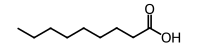
Nonanoic acid
Athanor · official
C9H18O2 · 158.24 g/mol
Also called pelargonic acid, C9:0, nonanoate
 WarningCauses skin irritation · Causes serious eye irritation · Harmful to aquatic life with long lasting effects
Names and identifiers
- IUPAC name
- nonanoic acid
- Synonyms
- pelargonic acid, C9:0, nonanoate
+ 38 more
Pelargonic acid, n-Nonanoic acid, Nonoic acid, Nonylic acid, Pelargic acid, 1-Octanecarboxylic acid, n-Nonylic acid, n-Nonoic acid, Pelargon, Hexacid C-9, Cirrasol 185A, Emfac 1202, 1-Octanecarboxyic acid, FEMA No. 2784, DTXSID3021641, CHEBI:29019, 97SEH7577T, NSC-62787, DTXCID901641, NSC62787, NSC-65450, NSC-65455, RefChem:166452, 203-931-2, pergonic acid, 1-nonanoic acid, MFCD00004433, Nonansaeure, Pelargonsaeure, NSC 62787, CH3-[CH2]7-COOH, N-Pelargonicacid, pergonate, n-nonanoate, FA 9:0, 1-nonanoate, 1-octanecarboxylate, Pelargon [Russian]
- Molecular formula
- C9H18O2
- Empirical formula
- C9H18O2
- Molecular weight
- 158.24 g/mol
- Exact mass
- 158.13068
- CAS number
- 112-05-0
- PubChem CID
- 8158
- Canonical SMILES
- CCCCCCCCC(=O)O
- Isomeric SMILES
- CCCCCCCCC(=O)O
- InChI
- InChI=1S/C9H18O2/c1-2-3-4-5-6-7-8-9(10)11/h2-8H2,1H3,(H,10,11)
- InChIKey
- FBUKVWPVBMHYJY-UHFFFAOYSA-N
- Molfile
Names, InChI and the identifiers from PubChem, retrieved 2026-10-14.
Physical properties
- Appearance
- Yellowish oil[2]
2 values
From Hazardous Substances Data Bank (HSDB), the most authoritative source here.
Value As written Source – Liquid; Large Crystals [1] EPA Chemical Data Reporting (CDR) –shown Yellowish oil [2] Hazardous Substances Data Bank (HSDB)cites Lewis, R.J. Sr.; Hawley's Condensed Chemical Dictionary 14th Edition. John Wiley & Sons, Inc. New York, NY 2001., p. 841 - Odor
- Slight odor[2]
2 values
From Hazardous Substances Data Bank (HSDB), the most authoritative source here.
Value As written Source – FATTY ODOR [2] Hazardous Substances Data Bank (HSDB)cites Fenaroli's Handbook of Flavor Ingredients. Volume 2. Edited, translated, and revised by T.E. Furia and N. Bellanca. 2nd ed. Cleveland: The Chemical Rubber Co., 1975., p. 433 –shown Slight odor [2] Hazardous Substances Data Bank (HSDB)cites Lewis, R.J. Sr.; Hawley's Condensed Chemical Dictionary 14th Edition. John Wiley & Sons, Inc. New York, NY 2001., p. 841 - Boiling point
- Boiling point = 255.6 °C[2]
2 values
Sources disagree; from Hazardous Substances Data Bank (HSDB), the most authoritative.
Value As written Source 255.6 °Cshown Boiling point = 255.6 °C [2] Hazardous Substances Data Bank (HSDB)cites Lewis, R.J. Sr.; Hawley's Condensed Chemical Dictionary 14th Edition. John Wiley & Sons, Inc. New York, NY 2001., p. 841 254 °C 254 °C @760 [mm Hg] [3] PAC Chemical Database, U.S. Department of Energy - Density
- 0.9055 @ 20°C[3]
- Solubility in water
- In water, 284 mg/L at 30 °C[2]
2 values
From Hazardous Substances Data Bank (HSDB), the most authoritative source here.
Value As written Source – 1:8 IN 50% ALCOHOL; 1:3 IN 60% ALCOHOL; INSOL IN WATER; SOL IN MOST ORG SOLVENTS [2] Hazardous Substances Data Bank (HSDB)cites Fenaroli's Handbook of Flavor Ingredients. Volume 2. Edited, translated, and revised by T.E. Furia and N. Bellanca. 2nd ed. Cleveland: The Chemical Rubber Co., 1975., p. 433 –shown In water, 284 mg/L at 30 °C [2] Hazardous Substances Data Bank (HSDB)cites Riddick, J.A., W.B. Bunger, Sakano T.K. Techniques of Chemistry 4th ed., Volume II. Organic Solvents. New York, NY: John Wiley and Sons., 1985., p. 375 - log P
- log Kow = 3.42[2]
- pKa
- pKa = 4.95 at 25 °C[2]
- Vapor pressure
- 1.65 × 10⁻³ mmHg at 25 °C[2]
2 values
2 of 2 sources agree on it (most common value).
Value As written Source 0.00165 mmHgshown 1.65X10⁻³ mm Hg at 25 °C [2] Hazardous Substances Data Bank (HSDB)cites Daubert, T.E., R.P. Danner. Physical and Thermodynamic Properties of Pure Chemicals Data Compilation. Washington, D.C.: Taylor and Francis, 1989. 0.00165 mmHg 0.00165 [mm Hg] @25 °C [3] PAC Chemical Database, U.S. Department of Energy - Flash point
- 133 °C (open cup)[2]
- Viscosity
- Reported, but no value passed the checks.
The value and why
- 8.08 mPa.sec at 20 °C (could not be read; source [2])
Each value as its source reports it, with the source's number after it (listed under References). Where several sources report a property, the row shows the value most of them agree on, the rule the app uses; open the values to see every one.
Calculated
- Heavy atoms
- 11
- Rings
- 0
- Aromatic rings
- 0
- Fraction sp³ carbons (Fsp3)
- 0.89
- H-bond donors
- 1
- H-bond acceptors
- 1 computed here · PubChem 2
- Rotatable bonds
- 7
- TPSA (Ų)
- 37.3
- Formal charge
- 0
- XLogP3
- 3.5 PubChem
- Complexity
- 99 PubChem
- Stereocenters
- None
- Double-bond geometry
- None specified
- Point group
- C1 of one 3D conformer with its hydrogens, by Athanor’s engine (as in the app)
Elemental analysis
- C68.31%
- H11.47%
- O20.22%
Isotope pattern
Each peak is a nominal mass with its abundance-weighted exact mass, as a percentage of the tallest, from IUPAC natural isotope abundances.
Computed from the structure with RDKit 2026.09 when this page was built, beside PubChem's own computed values from its record; where the two differ, both are shown.
Predicted
- log P
- 2.82 Crippen (Wildman and Crippen 1999)
- log S (water solubility)
- -2.14 ESOL (Delaney 2004), log mol/L
- Synthetic accessibility
- 1.51 SA score, 1 easy to 10 hard (Ertl and Schuffenhauer 2009)
Drug-likeness: Lipinski’s rule of five
- Molecular weight ≤ 500: 158.24
- log P ≤ 5 (Crippen): 2.82
- H-bond donors ≤ 5: 1
- H-bond acceptors ≤ 10: 1
Passes all four rules.
¹³C NMR shifts, predicted
Predictions, not measurements; each names its method. A measured log P, where a source reports one, is under Physical properties.
Safety
Warning
Harmonized EU classification (CLP Annex VI). Source [4].
- Harmful or irritant
- H315Causes skin irritation
- H319Causes serious eye irritation
- H412Harmful to aquatic life with long lasting effects
Precautionary statements: P264, P264+P265, P273, P280, P302+P352, P305+P351+P338, P321, P332+P317, P337+P317, P362+P364, P501
View all classifications (2)
- [4] Regulation (EC) No 1272/2008 of the European Parliament and of the Council · WarningH315, H319, H412
- [5] European Chemicals Agency (ECHA) · 2,504 reports · DangerH314, H315, H318, H319, H412
Storage
- Do not contaminate water, food, or feed by storage... . Keep conatiner tightly sealed when not in use. Store only in original container in a dry place inaccessible to children and pets. (scythe herbicide (57% pelargonic acid))[2]
Safety data sheets on the supplier’s page: Aladdin Scientific, Enamine, abcr GmbH.
Always read the supplier’s safety data sheet before working with it.
Spectra
- NMRHazardous Substances Data Bank (HSDB) · NMRShiftDB
- 1H NMRHuman Metabolome Database (HMDB) (Varian · 500 MHz · Water) · Human Metabolome Database (HMDB) (JEOL · 90 MHz · CDCl3) · Human Metabolome Database (HMDB) (Bruker · CDCl3) · SpectraBase (BRUKER AC-300)
- 13C NMRHazardous Substances Data Bank (HSDB) · Human Metabolome Database (HMDB) (Varian · 25.16 MHz · CDCl3) · Human Metabolome Database (HMDB) (Bruker · CDCl3) · SpectraBase
- 1H-13C NMRHuman Metabolome Database (HMDB) (Bruker · 600 MHz · CD3OD)
- GC-MSHuman Metabolome Database (HMDB) (GC-MS) · Human Metabolome Database (HMDB) (EI-B · positive) · Human Metabolome Database (HMDB) (EI-B · positive) · Human Metabolome Database (HMDB) (EI-B · positive) · Human Metabolome Database (HMDB) (GC-EI-TOF · positive) · Human Metabolome Database (HMDB) (GC-MS)
- MS-MSHuman Metabolome Database (HMDB) (Positive) · Human Metabolome Database (HMDB) (Positive) · Human Metabolome Database (HMDB) (Positive) · Human Metabolome Database (HMDB) (Quattro_QQQ · Positive) · Human Metabolome Database (HMDB) (Quattro_QQQ · Positive) · Human Metabolome Database (HMDB) (Quattro_QQQ · Positive)
- LC-MSMassBank Europe (Agilent 6560 QTOF · LC-ESI-QTOF · NEGATIVE) · MassBank Europe (maXis plus UHR-ToF-MS, Bruker Daltonics · LC-ESI-QTOF · POSITIVE) · MassBank Europe (maXis plus UHR-ToF-MS, Bruker Daltonics · LC-ESI-QTOF · POSITIVE) · MassBank Europe (maXis plus UHR-ToF-MS, Bruker Daltonics · LC-ESI-QTOF · POSITIVE) · MassBank Europe (maXis plus UHR-ToF-MS, Bruker Daltonics · LC-ESI-QTOF · NEGATIVE) · MassBank Europe (maXis plus UHR-ToF-MS, Bruker Daltonics · LC-ESI-QTOF · NEGATIVE)
- Other MSHazardous Substances Data Bank (HSDB) · MassBank Europe (HITACHI M-80 · EI-B · POSITIVE) · MassBank Europe (HITACHI M-80B · EI-B · POSITIVE) · MassBank Europe (GCMS-2010 Plus, Shimadzu · EI-B · POSITIVE) · MassBank of North America (MoNA) (positive) · MassBank of North America (MoNA) (negative)
- IRHazardous Substances Data Bank (HSDB)
- FTIRSpectraBase (NEAT (KBr))
- ATR-IRSpectraBase (Bruker Tensor 27 FT-IR · ATR-Neat (DuraSamplIR II))
- Near IRSpectraBase (INSTRUMENT PARAMETERS=INST=BRUKER,RSN=4712,REO=2,CNM=HEI,ZFF=2 · NIR Spectrometer= BRUKER IFS 88)
- Vapor Phase IRSpectraBase (DIGILAB FTS-14 · Vapor Phase)
- RamanSpectraBase (Bruker MultiRAM Stand Alone FT-Raman Spectrometer · FT-Raman)
Experimental spectra held by these sources; each link opens the source's own record.
Literature
Reading PubChem, OpenAlex and GSRS…
Bioactivity
Reading ChEMBL…
References
- [1]EPA Chemical Data Reporting (CDR) · Public domain (US EPA) · via PubChem · retrieved 2026-10-14
- [2]Hazardous Substances Data Bank (HSDB) · Public domain (US NLM) · via PubChem · retrieved 2026-10-14
- [3]PAC Chemical Database, U.S. Department of Energy · Public domain (US DOE) · via PubChem · retrieved 2026-10-14
- [4]Regulation (EC) No 1272/2008 of the European Parliament and of the Council · EU reuse policy, CC BY 4.0 · via PubChem · retrieved 2026-10-14
- [5]European Chemicals Agency (ECHA) · ECHA legal notice: reuse with acknowledgement · via PubChem · retrieved 2026-10-14
- [6]NMRShiftDB · Linked only · via PubChem · retrieved 2026-10-14
- [7]Human Metabolome Database (HMDB) · Linked only · via PubChem · retrieved 2026-10-14
- [8]SpectraBase · Linked only · via PubChem · retrieved 2026-10-14
- [9]MassBank Europe · Linked only · via PubChem · retrieved 2026-10-14
- [10]MassBank of North America (MoNA) · CC BY 4.0 · via PubChem · retrieved 2026-10-14
- [11]NIST Mass Spectrometry Data Center · Linked only · via PubChem · retrieved 2026-10-14
- ·Calculated values: computed by Athanor with RDKit 2026.09 from the structure.
- ·Literature on PubChem
Data last updated 2026-10-14.