
Linoleic acid
Athanor · official
C18H32O2 · 280.4 g/mol
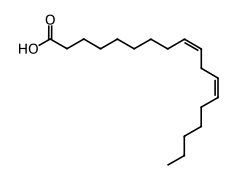
IUPAC name: (9Z,12Z)-octadeca-9,12-dienoic acid
Also called C18:2, omega-6, LA, essential fatty acid, linoleate
 WarningFlammable liquid and vapor
Names and identifiers
- IUPAC name
- (9Z,12Z)-octadeca-9,12-dienoic acid
- Synonyms
- C18:2, omega-6, LA
+ 39 more
essential fatty acid, linoleate, Linolic acid, (9Z,12Z)-octadeca-9,12-dienoic acid, Telfairic acid, cis,cis-Linoleic acid, 9,12-Linoleic acid, Unifac 6550, Emersol 315, alpha-Linoleic acid, cis-9,cis-12-Octadecadienoic acid, 9Z,12Z-Linoleic acid, cis,cis-9,12-Octadecadienoic acid, Emersol 310, (Z,Z)-9,12-Octadecadienoic acid, Extra Linoleic 90, 9Z,12Z-octadecadienoic acid, 9-cis,12-cis-Linoleic acid, all-cis-9,12-Octadecadienoic acid, Leinoleic acid, 9,12-Octadecadienoic acid (9Z,12Z)-, Ronacare asc 3, 9,12-Octadecadienoic acid (Z,Z)-, 9-cis,12-cis-Octadecadienoic acid, DTXSID2025505, (9Z,12Z)-Octadecadienoic acid, cis-delta9,12-Octadecadienoic acid, 9KJL21T0QJ, NSC-281243, CHEBI:17351, C18:2 (n-6), FEMA NO. 3380, LINOLEIC ACID-, DTXCID505505, NSC281243, [z,z]-9,12-octadecadienoic acid, 9 trans,12 trans Octadecadienoic Acid, RefChem:6456, Linoleic Acid, (E,E)-, 9,12 Octadecadienoic Acid
- Molecular formula
- C18H32O2
- Empirical formula
- C9H16O
- Molecular weight
- 280.4 g/mol
- Exact mass
- 280.24023
- CAS number
- 60-33-3
- PubChem CID
- 5280450
- Canonical SMILES
- CCCCCC=CCC=CCCCCCCCC(=O)O
- Isomeric SMILES
- CCCCC/C=C\C/C=C\CCCCCCCC(=O)O
- InChI
- InChI=1S/C18H32O2/c1-2-3-4-5-6-7-8-9-10-11-12-13-14-15-16-17-18(19)20/h6-7,9-10H,2-5,8,11-17H2,1H3,(H,19,20)/b7-6-,10-9-
- InChIKey
- OYHQOLUKZRVURQ-HZJYTTRNSA-N
- Molfile
Names, InChI and the identifiers from PubChem, retrieved 2026-10-14.
Physical properties
- Appearance
- Colorless to straw-colored liquid[3]
3 values
From Hazardous Substances Data Bank (HSDB), the most authoritative source here.
Value As written Source – Linoleic acid is a colorless to straw colored liquid. A polyunsaturated fatty acid essential to human diet. [1] CAMEO Chemicals – CBI; Liquid; Other Solid; Liquid [2] EPA Chemical Data Reporting (CDR) –shown Colorless to straw-colored liquid [3] Hazardous Substances Data Bank (HSDB)cites Lewis, R.J. Sr.; Hawley's Condensed Chemical Dictionary 15th Edition. John Wiley & Sons, Inc. New York, NY 2007., p. 759 - Melting point
- -5 °C (23 °F, NTP 1992)[1]
- Boiling point
- 229 to 230 °C (444 to 446 °F) at 16 mmHg (NTP, 1992)[1]
- Density
- 0.9007 at 22 °C (72 °F) (NTP, 1992) - Less dense than water[1]
- Solubility in water
- In water, 1.59 mg/L at 25 °C[3]
3 values
From Hazardous Substances Data Bank (HSDB), the most authoritative source here.
Value As written Source – Insoluble (NTP, 1992) [1] CAMEO Chemicalscites National Toxicology Program, Institute of Environmental Health Sciences, National Institutes of Health (NTP). 1992. National Toxicology Program Chemical Repository Database. Research Triangle Park, North Carolina. –shown In water, 1.59 mg/L at 25 °C [3] Hazardous Substances Data Bank (HSDB)cites Mabrouk AF, Dugan LR Jr; J American Oil Chemists Society 38(1): 9-13 (1961) – In acetone: 4.10 g/100 g acetone at -50 °C, 1.20 g/100 g acetone at -60 °C, 0.35 g/100 g acetone at -70 °C; in n-heptane: 0.98 g/100 g n-heptane at -50 °C, 0.20 g/100 g n-heptane at -60 °C, 0.042 g/100 g n-heptane at -70 °C. [3] Hazardous Substances Data Bank (HSDB)cites Kirk-Othmer Encyclopedia of Chemical Technology. 4th ed. Volumes 1: New York, NY. John Wiley and Sons, 1991-Present., p. V5: 159 (1993) - log P
- log Kow = 7.05[3]
- pKa
- pKa = 4.77 at 25 °C[3]
- Vapor pressure
- 8.68 × 10⁻⁷ mmHg at 25 °C[3]
- Refractive index
- Index of refraction: 1.4710 at 15 °C[3]
Each value as its source reports it, with the source's number after it (listed under References). Where several sources report a property, the row shows the value most of them agree on, the rule the app uses; open the values to see every one.
Calculated
- Heavy atoms
- 20
- Rings
- 0
- Aromatic rings
- 0
- Fraction sp³ carbons (Fsp3)
- 0.72
- H-bond donors
- 1
- H-bond acceptors
- 1 computed here · PubChem 2
- Rotatable bonds
- 14
- TPSA (Ų)
- 37.3
- Formal charge
- 0
- XLogP3
- 6.8 PubChem
- Complexity
- 267 PubChem
- Stereocenters
- None
- Double-bond geometry
- C6=C7: Z · C9=C10: Z
- Point group
- C1 of one 3D conformer with its hydrogens, by Athanor’s engine (as in the app)
Elemental analysis
- C77.09%
- H11.50%
- O11.41%
Isotope pattern
Each peak is a nominal mass with its abundance-weighted exact mass, as a percentage of the tallest, from IUPAC natural isotope abundances.
Computed from the structure with RDKit 2026.09 when this page was built, beside PubChem's own computed values from its record; where the two differ, both are shown.
Predicted
- log P
- 5.88 Crippen (Wildman and Crippen 1999)
- log S (water solubility)
- -4.36 ESOL (Delaney 2004), log mol/L
- Synthetic accessibility
- 2.29 SA score, 1 easy to 10 hard (Ertl and Schuffenhauer 2009)
Drug-likeness: Lipinski’s rule of five
- Molecular weight ≤ 500: 280.45
- log P ≤ 5 (Crippen): 5.88
- H-bond donors ≤ 5: 1
- H-bond acceptors ≤ 10: 1
Breaks 1 of the four rules.
¹³C NMR shifts, predicted
Predictions, not measurements; each names its method. A measured log P, where a source reports one, is under Physical properties.
Safety
Warning
Most widely reported: 212 company reports to ECHA. Source [4].
- Flammable
- H226Flammable liquid and vapor (17% of reports)
Precautionary statements: P210, P233, P240, P241, P242, P243, P280, P303+P361+P353, P370+P378, P403+P235, P501
View all classifications (3)
- [4] European Chemicals Agency (ECHA) · 2,465 reportsThis chemical does not meet GHS hazard criteria for 90.2% (2223 of 2465) of all reports.
- [4] European Chemicals Agency (ECHA)This chemical does not meet GHS hazard criteria for 82.5% (175 of 212) of all reports.
- [4] European Chemicals Agency (ECHA) · 212 reports · WarningH226
First aid
- Eyes: First check the victim for contact lenses and remove if present. Flush victim's eyes with water or normal saline solution for 20 to 30 minutes while simultaneously calling a hospital or poison control center. Do not put any ointments, oils, or medication in the victim's eyes without specific instructions from a physician. Immediately transport the victim after flushing eyes to a hospital even if no symptoms (such as redness or irritation) develop. Skin: Immediately flood affected skin with water while removing and isolating all contaminated clothing.[1]
Safety data sheets on the supplier’s page: Shenghe Chemical, RR Scientific, DempoChem.
Always read the supplier’s safety data sheet before working with it.
Spectra
- NMRHazardous Substances Data Bank (HSDB)
- 1H NMRHuman Metabolome Database (HMDB) (Varian · 500 MHz · Water) · Human Metabolome Database (HMDB) (JEOL · 90 MHz · CDCl3) · SpectraBase
- 13C NMRSpectraBase
- 1H-13C NMRHuman Metabolome Database (HMDB) (Bruker · 600 MHz · CDCl3)
- GC-MSHuman Metabolome Database (HMDB) (GC-EI-TOF · positive) · Human Metabolome Database (HMDB) (GC-EI-TOF · positive) · Human Metabolome Database (HMDB) (GC-MS) · Human Metabolome Database (HMDB) (GC-EI-TOF (Pegasus III TOF-MS system, Leco; GC 6890, Agilent Technologies) · Positive) · Human Metabolome Database (HMDB) (GC-EI-TOF (Pegasus III TOF-MS system, Leco; GC 6890, Agilent Technologies) · Positive) · Human Metabolome Database (HMDB) (GC-MS)
- MS-MSHuman Metabolome Database (HMDB) (Negative) · Human Metabolome Database (HMDB) (Positive) · Human Metabolome Database (HMDB) (Positive) · Human Metabolome Database (HMDB) (Positive) · Human Metabolome Database (HMDB) (Negative) · Human Metabolome Database (HMDB) (Negative)
- LC-MSMassBank Europe (Agilent 6560 QTOF · LC-ESI-QTOF · NEGATIVE) · MassBank Europe (Agilent 6560 QTOF · LC-ESI-QTOF · NEGATIVE) · MassBank Europe (Agilent 6560 QTOF · LC-ESI-QTOF · NEGATIVE) · MassBank Europe (maXis plus UHR-ToF-MS, Bruker Daltonics · LC-ESI-QTOF · POSITIVE) · MassBank Europe (maXis plus UHR-ToF-MS, Bruker Daltonics · LC-ESI-QTOF · POSITIVE) · MassBank Europe (maXis plus UHR-ToF-MS, Bruker Daltonics · LC-ESI-QTOF · POSITIVE)
- Other MSHazardous Substances Data Bank (HSDB) · MassBank Europe (JMS-HX/HX 110A, JEOL · FAB-EBEB · NEGATIVE) · MassBank of North America (MoNA) (TQD, Waters · Flow-injection QqQ/MS · ESI) · MassBank of North America (MoNA) (TQD, Waters · Flow-injection QqQ/MS · ESI) · MassBank of North America (MoNA) (TQD, Waters · Flow-injection QqQ/MS · ESI)
- UVHazardous Substances Data Bank (HSDB)
- IRHazardous Substances Data Bank (HSDB)
- FTIRSpectraBase (BETWEEN SALTS)
- ATR-IRSpectraBase (Bio-Rad FTS · ATR-Neat (DuraSamplIR II))
- Vapor Phase IRSpectraBase (DIGILAB FTS-14 · Vapor Phase)
- RamanSpectraBase
Experimental spectra held by these sources; each link opens the source's own record.
Literature
Reading PubChem, OpenAlex and GSRS…
Bioactivity
Reading ChEMBL…
References
- [1]CAMEO Chemicals · Public domain (NOAA) · via PubChem · retrieved 2026-10-14
- [2]EPA Chemical Data Reporting (CDR) · Public domain (US EPA) · via PubChem · retrieved 2026-10-14
- [3]Hazardous Substances Data Bank (HSDB) · Public domain (US NLM) · via PubChem · retrieved 2026-10-14
- [4]European Chemicals Agency (ECHA) · ECHA legal notice: reuse with acknowledgement · via PubChem · retrieved 2026-10-14
- [5]Human Metabolome Database (HMDB) · Linked only · via PubChem · retrieved 2026-10-14
- [6]SpectraBase · Linked only · via PubChem · retrieved 2026-10-14
- [7]MassBank Europe · Linked only · via PubChem · retrieved 2026-10-14
- [8]MassBank of North America (MoNA) · CC BY 4.0 · via PubChem · retrieved 2026-10-14
- [9]NIST Mass Spectrometry Data Center · Linked only · via PubChem · retrieved 2026-10-14
- ·Calculated values: computed by Athanor with RDKit 2026.09 from the structure.
- ·Literature on PubChem
Data last updated 2026-10-14.