
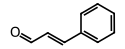
Cinnamaldehyde
Athanor · official
C9H8O · 132.16 g/mol
IUPAC name: (E)-3-phenylprop-2-enal
Also called cinnamon, cinnamal
 WarningMay cause an allergic skin reaction
Names and identifiers
- IUPAC name
- (E)-3-phenylprop-2-enal
- Synonyms
- cinnamon, cinnamal, Zimtaldehyde
+ 37 more
Cinnamal, 3-Phenylacrylaldehyde, 2-Propenal, 3-phenyl-, Phenylacrolein, 3-Phenylpropenal, 3-Phenyl-2-propenal, (E)-3-phenylprop-2-enal, Cassia aldehyde, Cinnamylaldehyde, 3-Phenylacrolein, (E)-3-Phenyl-2-propenal, Cinnemaldehyde, Cinnamyl aldehyde, Abion CA, Benzylideneacetaldehyde, beta-Phenylcrolein, 3-Fenylpropenal, 3-Phenyl-2-propenaldehyde, 3-Phenyl-2-propen-1-al, Acrolein, 3-phenyl-, FEMA No. 2286, Aldehyd skoricovy, NCI-C56111, Hefty Dog and Cat Repellent, SR60A3XG0F, NSC-16935, NSC-40346, (3E)-3-phenylprop-2-enal, (E)-3-Phenyl-propenal, XC-800, NSC16935, beta-phenylacrolein, RefChem:126247, cinnamic aldehyde, (E)-, trans-3-phenylprop-2-enaldehyde, 203-213-9, 604-377-8
- Molecular formula
- C9H8O
- Empirical formula
- C9H8O
- Molecular weight
- 132.16 g/mol
- Exact mass
- 132.05751
- CAS number
- 104-55-2
- PubChem CID
- 637511
- Canonical SMILES
- C1=CC=C(C=C1)C=CC=O
- Isomeric SMILES
- C1=CC=C(C=C1)/C=C/C=O
- InChI
- InChI=1S/C9H8O/c10-8-4-7-9-5-2-1-3-6-9/h1-8H/b7-4+
- InChIKey
- KJPRLNWUNMBNBZ-QPJJXVBHSA-N
- Molfile
Names, InChI and the identifiers from PubChem, retrieved 2026-10-14.
Physical properties
- Appearance
- CBI; Other Solid; Liquid[1]
2 values
From EPA Chemical Data Reporting (CDR), the most authoritative source here.
Value As written Source –shown CBI; Other Solid; Liquid [1] EPA Chemical Data Reporting (CDR) – GREENISH-YELLOW LIQUID [2] Hazardous Substances Data Bank (HSDB)cites Fenaroli's Handbook of Flavor Ingredients. Volume 2. Edited, translated, and revised by T.E. Furia and N. Bellanca. 2nd ed. Cleveland: The Chemical Rubber Co., 1975., p. 91 - Odor
- PUNGENT, SPICY NOTE[2]
- Solubility in water
- In water, 1.42 × 10³ mg/L at 25 °C[2]
2 values
From Hazardous Substances Data Bank (HSDB), the most authoritative source here.
Value As written Source – SOLUBILITY: 1:5 IN 60%, 1:25 IN 50%, 1:2.5 IN 70% ALC [2] Hazardous Substances Data Bank (HSDB)cites Fenaroli's Handbook of Flavor Ingredients. Volume 2. Edited, translated, and revised by T.E. Furia and N. Bellanca. 2nd ed. Cleveland: The Chemical Rubber Co., 1975., p. 91 –shown In water, 1.42X10+3 mg/L at 25 °C [2] Hazardous Substances Data Bank (HSDB)cites PMID:7241352 Valvani SC et al; J Pharm Sci 70: 502-7 (1981) - log P
- log Kow = 1.90[2]
- Vapor pressure
- 2.89 × 10⁻² mmHg at 25 °C[2]
- Flash point
- 120 °C closed cup[2]
Each value as its source reports it, with the source's number after it (listed under References). Where several sources report a property, the row shows the value most of them agree on, the rule the app uses; open the values to see every one.
Calculated
- Heavy atoms
- 10
- Rings
- 1
- Aromatic rings
- 1
- Fraction sp³ carbons (Fsp3)
- 0
- H-bond donors
- 0
- H-bond acceptors
- 1
- Rotatable bonds
- 2
- TPSA (Ų)
- 17.1
- Formal charge
- 0
- XLogP3
- 1.9 PubChem
- Complexity
- 121 PubChem
- Stereocenters
- None
- Double-bond geometry
- C3=C4: E
- Point group
- Cs of one 3D conformer with its hydrogens, by Athanor’s engine (as in the app)
Elemental analysis
- C81.79%
- H6.10%
- O12.11%
Isotope pattern
Each peak is a nominal mass with its abundance-weighted exact mass, as a percentage of the tallest, from IUPAC natural isotope abundances.
Computed from the structure with RDKit 2026.09 when this page was built, beside PubChem's own computed values from its record; where the two differ, both are shown.
Predicted
- log P
- 1.9 Crippen (Wildman and Crippen 1999)
- log S (water solubility)
- -2.17 ESOL (Delaney 2004), log mol/L
- Synthetic accessibility
- 1.93 SA score, 1 easy to 10 hard (Ertl and Schuffenhauer 2009)
Drug-likeness: Lipinski’s rule of five
- Molecular weight ≤ 500: 132.16
- log P ≤ 5 (Crippen): 1.9
- H-bond donors ≤ 5: 0
- H-bond acceptors ≤ 10: 1
Passes all four rules.
¹³C NMR shifts, predicted
Predictions, not measurements; each names its method. A measured log P, where a source reports one, is under Physical properties.
Safety
Warning
Harmonized EU classification (CLP Annex VI). Source [3].
- Harmful or irritant
- H317May cause an allergic skin reaction
Precautionary statements: P261, P272, P280, P302+P352, P321, P333+P317, P362+P364, P501
View all classifications (8)
- [3] Regulation (EC) No 1272/2008 of the European Parliament and of the Council · WarningH317
- [3] Regulation (EC) No 1272/2008 of the European Parliament and of the Council · WarningH317
- [4] European Chemicals Agency (ECHA)This chemical does not meet GHS hazard criteria for 0.2% (5 of 2854) of reports.
- [4] European Chemicals Agency (ECHA) · 2,854 reports · WarningH312, H315, H317, H319
- [4] European Chemicals Agency (ECHA)This chemical does not meet GHS hazard criteria for 1.9% (3 of 161) of reports.
- [4] European Chemicals Agency (ECHA) · 161 reports · WarningH312, H315, H317, H319, H335, H412
- [4] European Chemicals Agency (ECHA) · 37 reportsThis chemical does not meet GHS hazard criteria for 100% (37 of 37) of all reports.
- [4] European Chemicals Agency (ECHA) · WarningH315, H317, H319, H335
Storage
- Do not use, pour, spill or store near heat or open flame. (cinnacure A3005)[2]
Incompatibilities
- Rags soaked in sodium hydroxide and in (cinnamaldehyde) overheated and ignited owing to aerobic oxidation when they came into contact in a waste bin.[2]
Safety data sheets on the supplier’s page: AppChem, abcr GmbH, Alfa Chemistry.
Always read the supplier’s safety data sheet before working with it.
Spectra
- NMRHazardous Substances Data Bank (HSDB) · NMRShiftDB
- 1H NMRHuman Metabolome Database (HMDB) (600 MHz · Methanol) · Human Metabolome Database (HMDB) (Bruker · 600 MHz · CD3OD) · SpectraBase (BRUKER AC-300)
- 13C NMRHazardous Substances Data Bank (HSDB) · SpectraBase
- 17O NMRSpectraBase
- 1H-13C NMRHuman Metabolome Database (HMDB) (Bruker · 600 MHz · CD3OD)
- GC-MSHuman Metabolome Database (HMDB) (GC-MS) · Human Metabolome Database (HMDB) (EI-B · positive) · Human Metabolome Database (HMDB) (EI-B · positive) · Human Metabolome Database (HMDB) (EI-B · positive) · Human Metabolome Database (HMDB) (EI-B · positive) · Human Metabolome Database (HMDB) (EI-B · positive)
- MS-MSHuman Metabolome Database (HMDB) (LC-ESI-QTOF · positive) · Human Metabolome Database (HMDB) (EI-B (HITACHI RMU-7M) · Positive) · Human Metabolome Database (HMDB) (EI-B (JEOL JMS-D-3000) · Positive) · Human Metabolome Database (HMDB) (EI-B (SHIMADZU QP-1000) · Positive) · Human Metabolome Database (HMDB) (Quattro_QQQ · Positive) · Human Metabolome Database (HMDB) (Quattro_QQQ · Positive)
- LC-MSMassBank Europe (UPLC Q-Tof Premier, Waters · LC-ESI-QTOF · POSITIVE) · MassBank of North America (MoNA) (Q-Exactive Plus · positive) · MassBank of North America (MoNA) (Quattro_QQQ · positive) · MassBank of North America (MoNA) (UPLC Q-Tof Premier, Waters · LC-ESI-QTOF · ESI) · MassBank of North America (MoNA) (Q-Tof Premier, Waters · LC-Q-TOF/MS · ESI)
- Other MSHazardous Substances Data Bank (HSDB) · MassBank Europe (HITACHI RMU-7M · EI-B · POSITIVE) · MassBank Europe (JEOL JMS-D-3000 · EI-B · POSITIVE) · MassBank Europe (SHIMADZU QP-1000 · EI-B · POSITIVE) · MassBank Europe (SHIMADZU QP-1000 · EI-B · POSITIVE) · MassBank Europe (HITACHI RMU-6M · EI-B · POSITIVE)
- UVHazardous Substances Data Bank (HSDB)
- IRHazardous Substances Data Bank (HSDB)
- FTIRSpectraBase (Bruker IFS 85 · Cell)
- ATR-IRSpectraBase
- Near IRSpectraBase (INSTRUMENT PARAMETERS=INST=BRUKER,RSN=10136,REO=2,CNM=HEI,ZFF=2 · NIR Spectrometer= BRUKER IFS 88)
- Vapor Phase IRSpectraBase (Bruker IFS 85 · Gas-GC)
- RamanSpectraBase
Experimental spectra held by these sources; each link opens the source's own record.
Literature
Reading PubChem, OpenAlex and GSRS…
Bioactivity
Reading ChEMBL…
References
- [1]EPA Chemical Data Reporting (CDR) · Public domain (US EPA) · via PubChem · retrieved 2026-10-14
- [2]Hazardous Substances Data Bank (HSDB) · Public domain (US NLM) · via PubChem · retrieved 2026-10-14
- [3]Regulation (EC) No 1272/2008 of the European Parliament and of the Council · EU reuse policy, CC BY 4.0 · via PubChem · retrieved 2026-10-14
- [4]European Chemicals Agency (ECHA) · ECHA legal notice: reuse with acknowledgement · via PubChem · retrieved 2026-10-14
- [5]NMRShiftDB · Linked only · via PubChem · retrieved 2026-10-14
- [6]Human Metabolome Database (HMDB) · Linked only · via PubChem · retrieved 2026-10-14
- [7]SpectraBase · Linked only · via PubChem · retrieved 2026-10-14
- [8]MassBank of North America (MoNA) · CC BY 4.0 · via PubChem · retrieved 2026-10-14
- [9]NIST Mass Spectrometry Data Center · Linked only · via PubChem · retrieved 2026-10-14
- [10]MassBank Europe · Linked only · via PubChem · retrieved 2026-10-14
- ·Calculated values: computed by Athanor with RDKit 2026.09 from the structure.
- ·Literature on PubChem
Data last updated 2026-10-14.