
Trimethoprim
Athanor · official
C14H18N4O3 · 290.32 g/mol
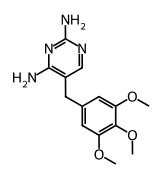
IUPAC name: 5-[(3,4,5-trimethoxyphenyl)methyl]pyrimidine-2,4-diamine
Also called Proloprim, co-trimoxazole


 DangerHarmful if swallowed · Suspected of damaging fertility or the unborn child · Causes damage to organs through prolonged or repeated exposure · Toxic to aquatic life with long lasting effects
Names and identifiers
- IUPAC name
- 5-[(3,4,5-trimethoxyphenyl)methyl]pyrimidine-2,4-diamine
- Synonyms
- Proloprim, co-trimoxazole, Trimpex
+ 36 more
2,4-Diamino-5-(3,4,5-trimethoxybenzyl)pyrimidine, Trimetoprim, Monotrim, Trimopan, Wellcoprim, Syraprim, Monoprim, Uretrim, Trimethoprime, Trimethoprimum, 5-[(3,4,5-trimethoxyphenyl)methyl]pyrimidine-2,4-diamine, Trimetoprima, Tiempe, Trimpex 200, NSC-106568, BW 56-72, NIH 204, Trimogal, Infectotrimet, DTXSID3023712, 2,4-Pyrimidinediamine, 5-[(3,4,5-trimethoxyphenyl)methyl]-, BW-56-72, 5-(3,4,5-Trimethoxybenzyl)-2,4-diaminopyrimidine, NIH-204, 5-((3,4,5-Trimethoxyphenyl)methyl)-2,4-pyrimidinediamine, 5-[(3,4,5-Trimethoxyphenyl)methyl]-2,4-pyrimidinediamine, AN164J8Y0X, 2,4-Pyrimidinediamine, 5-((3,4,5-trimethoxyphenyl)methyl)-, CHEBI:45924, Pyrimidine, 2,4-diamino-5-(3,4,5-trimethoxybenzyl)-, NSC106568, DTXCID803712, 5-((3,4,5-trimethoxyphenyl)methyl)pyrimidine-2,4-diamine, Ledatrim, Proloprin, Triprimix 200
- Molecular formula
- C14H18N4O3
- Empirical formula
- C14H18N4O3
- Molecular weight
- 290.32 g/mol
- Exact mass
- 290.13789
- CAS number
- 738-70-5
- PubChem CID
- 5578
- Canonical SMILES
- COC1=CC(=CC(=C1OC)OC)CC2=CN=C(N=C2N)N
- Isomeric SMILES
- COC1=CC(=CC(=C1OC)OC)CC2=CN=C(N=C2N)N
- InChI
- InChI=1S/C14H18N4O3/c1-19-10-5-8(6-11(20-2)12(10)21-3)4-9-7-17-14(16)18-13(9)15/h5-7H,4H2,1-3H3,(H4,15,16,17,18)
- InChIKey
- IEDVJHCEMCRBQM-UHFFFAOYSA-N
- Molfile
Names, InChI and the identifiers from PubChem, retrieved 2026-10-14.
Physical properties
- Appearance
- Trimethoprim is an odorless white powder. Bitter taste. (NTP, 1992)[1]
- Odor
- Odorless[2]
- Melting point
- 199 to 203 °C (390 to 397 °F, NTP 1992)[1]
- Solubility in water
- In water, 400 mg/l @ 25 °C[2]
3 values
From Hazardous Substances Data Bank (HSDB), the most authoritative source here.
Value As written Source – less than 1 mg/mL at 75 °F (NTP, 1992) [1] CAMEO Chemicalscites National Toxicology Program, Institute of Environmental Health Sciences, National Institutes of Health (NTP). 1992. National Toxicology Program Chemical Repository Database. Research Triangle Park, North Carolina. – ... Very slightly soluble in water and slightly soluble in alcohol. [2] Hazardous Substances Data Bank (HSDB)cites McEvoy, G.K. (ed.). American Hospital Formulary Service - Drug Information 92. Bethesda, MD: American Society of Hospital Pharmacists, Inc., 1992 (Plus Supplements 1992)., p. 453 –shown In water, 400 mg/l @ 25 °C [2] Hazardous Substances Data Bank (HSDB)cites Yalkowsky SH, Dannenfelser RM; The AQUASOL dATAbASE of Aqueous Solubility. Ver 5. Tucson, AZ: Univ AZ, College of Pharmacy (1992) - log P
- log Kow = 0.91[2]
- pKa
- pKa= 7.12 (conjugate acid)[2]
Each value as its source reports it, with the source's number after it (listed under References). Where several sources report a property, the row shows the value most of them agree on, the rule the app uses; open the values to see every one.
Calculated
- Heavy atoms
- 21
- Rings
- 2
- Aromatic rings
- 2
- Fraction sp³ carbons (Fsp3)
- 0.29
- H-bond donors
- 2
- H-bond acceptors
- 7
- Rotatable bonds
- 5
- TPSA (Ų)
- 105.5 computed here · PubChem 106
- Formal charge
- 0
- XLogP3
- 0.9 PubChem
- Complexity
- 307 PubChem
- Stereocenters
- None
- Double-bond geometry
- None specified
- Point group
- C1 of one 3D conformer with its hydrogens, by Athanor’s engine (as in the app)
Elemental analysis
- C57.92%
- H6.25%
- N19.30%
- O16.53%
Isotope pattern
Each peak is a nominal mass with its abundance-weighted exact mass, as a percentage of the tallest, from IUPAC natural isotope abundances.
Computed from the structure with RDKit 2026.09 when this page was built, beside PubChem's own computed values from its record; where the two differ, both are shown.
Predicted
- log P
- 1.26 Crippen (Wildman and Crippen 1999)
- log S (water solubility)
- -2.53 ESOL (Delaney 2004), log mol/L
- Synthetic accessibility
- 2.21 SA score, 1 easy to 10 hard (Ertl and Schuffenhauer 2009)
Drug-likeness: Lipinski’s rule of five
- Molecular weight ≤ 500: 290.32
- log P ≤ 5 (Crippen): 1.26
- H-bond donors ≤ 5: 2
- H-bond acceptors ≤ 10: 7
Passes all four rules.
¹³C NMR shifts, predicted
Predictions, not measurements; each names its method. A measured log P, where a source reports one, is under Physical properties.
Safety
Danger
Most widely reported: 140 company reports to ECHA. Source [3].
- Harmful or irritant
- Health hazard
- Environmental hazard
- H302Harmful if swallowed (85% of reports)
- H361Suspected of damaging fertility or the unborn child (30.7% of reports)
- H372Causes damage to organs through prolonged or repeated exposure (26.4% of reports)
- H411Toxic to aquatic life with long lasting effects (26.4% of reports)
Precautionary statements: P203, P260, P264, P270, P273, P280, P301+P317, P318, P319, P330, P391, P405, P501
View all classifications (2)
- [3] European Chemicals Agency (ECHA)This chemical does not meet GHS hazard criteria for 7.9% (11 of 140) of reports.
- [3] European Chemicals Agency (ECHA) · 140 reports · DangerH302, H361, H372, H411
First aid
- Eyes: First check the victim for contact lenses and remove if present. Flush victim's eyes with water or normal saline solution for 20 to 30 minutes while simultaneously calling a hospital or poison control center. Do not put any ointments, oils, or medication in the victim's eyes without specific instructions from a physician. Immediately transport the victim after flushing eyes to a hospital even if no symptoms (such as redness or irritation) develop. Skin: Immediately flood affected skin with water while removing and isolating all contaminated clothing.[1]
Storage
Safety data sheets on the supplier’s page: LGC Standards, Sigma-Aldrich, Clinivex.
Always read the supplier’s safety data sheet before working with it.
Spectra
- 13C NMRSpectraBase (Jeol GX-270)
- 15N NMRSpectraBase
- GC-MSHuman Metabolome Database (HMDB) (EI-B · positive) · MassBank of North America (MoNA) (HITACHI M-80 · EI-B · positive) · MassBank of North America (MoNA) (HITACHI M-80 · EI-B · positive) · NIST Mass Spectrometry Data Center · NIST Mass Spectrometry Data Center · NIST Mass Spectrometry Data Center
- MS-MSHuman Metabolome Database (HMDB) (Positive) · Human Metabolome Database (HMDB) (Positive) · Human Metabolome Database (HMDB) (Positive) · Human Metabolome Database (HMDB) (Positive) · Human Metabolome Database (HMDB) (Positive) · Human Metabolome Database (HMDB) (Positive)
- LC-MSMassBank Europe (QExactive Orbitrap HF-X (Thermo Scientific) · LC-ESI-QFT · POSITIVE) · MassBank Europe (QExactive Orbitrap HF-X (Thermo Scientific) · LC-ESI-QFT · NEGATIVE) · MassBank Europe (Exploris 480 Orbitrap (Thermo Scientific) · LC-ESI-QFT · POSITIVE) · MassBank Europe (Exploris 480 Orbitrap (Thermo Scientific) · LC-ESI-QFT · NEGATIVE) · MassBank Europe (Bruker maXis Impact · LC-ESI-QTOF · POSITIVE) · MassBank Europe (Bruker maXis Impact · LC-ESI-QTOF · POSITIVE)
- Other MSMassBank Europe (QExactive Orbitrap HF-X (Thermo Scientific) · LC-APCI-QFT · POSITIVE) · MassBank Europe (HITACHI M-80 · EI-B · POSITIVE) · MassBank Europe (Xevo G2 XS QTOF, waters · ESI-QTOF · POSITIVE) · MassBank of North America (MoNA) (Xevo G2 XS QTOF, waters · ESI-QTOF · ESI)
- UV-VISSpectraBase
- FTIRSpectraBase (KBr WAFER)
- ATR-IRSpectraBase (Bio-Rad FTS · ATR-Neat (DuraSamplIR II) ground)
Experimental spectra held by these sources; each link opens the source's own record.
Literature
Reading PubChem, OpenAlex and GSRS…
Bioactivity
Reading ChEMBL…
References
- [1]CAMEO Chemicals · Public domain (NOAA) · via PubChem · retrieved 2026-10-14
- [2]Hazardous Substances Data Bank (HSDB) · Public domain (US NLM) · via PubChem · retrieved 2026-10-14
- [3]European Chemicals Agency (ECHA) · ECHA legal notice: reuse with acknowledgement · via PubChem · retrieved 2026-10-14
- [4]SpectraBase · Linked only · via PubChem · retrieved 2026-10-14
- [5]Human Metabolome Database (HMDB) · Linked only · via PubChem · retrieved 2026-10-14
- [6]MassBank of North America (MoNA) · CC BY 4.0 · via PubChem · retrieved 2026-10-14
- [7]NIST Mass Spectrometry Data Center · Linked only · via PubChem · retrieved 2026-10-14
- [8]MassBank Europe · Linked only · via PubChem · retrieved 2026-10-14
- ·Calculated values: computed by Athanor with RDKit 2026.09 from the structure.
- ·Literature on PubChem
Data last updated 2026-10-14.